

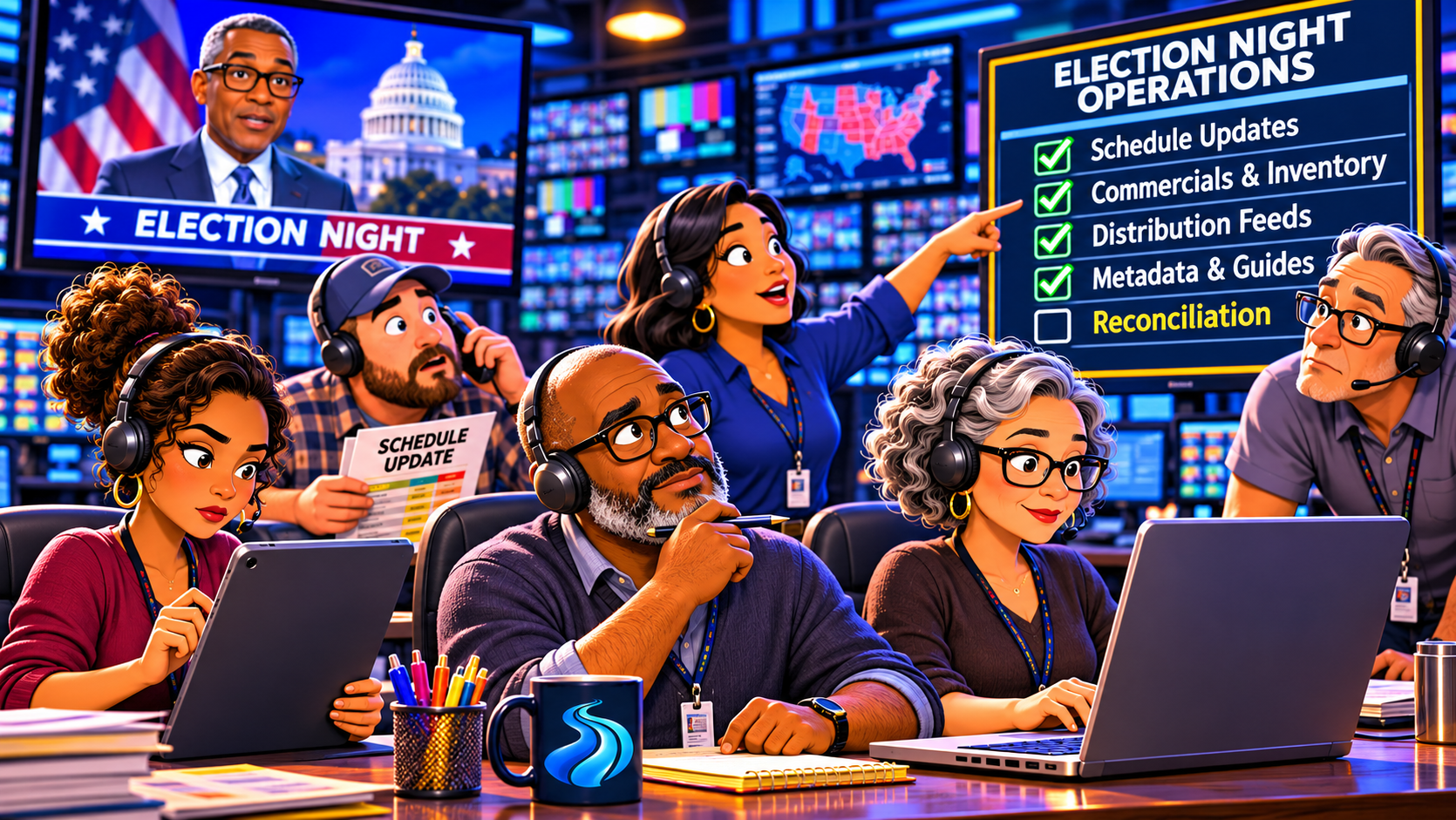
Election Night is one of those events that reminds us just how complicated television operations can become.
For viewers, the experience is relatively straightforward. They turn on a network, streaming service, or local station and follow the results as they come in.
Behind the scenes, however, there is an entirely different story.
Having worked across broadcast traffic, scheduling, and systems implementations, I've seen how quickly a change to one part of an operation can affect everything connected to it.
Election coverage is a particularly good example because it combines nearly every operational challenge into a single evening: unpredictable timing, live programming, commercial obligations, schedule changes, multiple distribution platforms, and the need to reconcile what actually aired.
With the November 3 midterm elections approaching, I think it's worth looking at some of the operational lessons that apply well beyond election coverage.
1. One Event Doesn't Mean One Workflow
One of the biggest changes in television operations is that a single event no longer means a single transmission schedule.
This year's election coverage will extend across broadcast networks, streaming services, connected television, and digital platforms.
CBS News, for example, has announced coverage across CBS, CBS News 24/7, Paramount+, and digital outlets. NBCUniversal is coordinating coverage across NBC News, Telemundo, Peacock, and other platforms.
From an operations perspective, each distribution outlet can have different requirements.
One feed may carry national commercials while another has a different advertising structure. A local station may need to accommodate its own coverage. A streaming service may continue broadcasting after the traditional network has signed off.
The difficulty isn't necessarily getting the same content to multiple destinations. It's managing the differences between those destinations.
I've always considered this one of the most important distinctions in multiplatform operations. The content may be shared, but the operational requirements frequently are not.
Operational Lesson: Design workflows around the specific requirements of each distribution platform rather than assuming one schedule, commercial structure, or set of instructions will work everywhere.
2. The Schedule Will Change. The Question Is How You Manage It.
Anyone who has worked in broadcast scheduling knows that the published schedule is not always the schedule that ultimately airs.
Live events make that especially clear.
Election coverage may extend because a race hasn't been called, a network decides to remain with a developing story, or a local station needs additional time.
A 30-minute extension might seem relatively minor, but depending on the operation, that single decision can affect programming, commercial inventory, transmission instructions, electronic program guides, and downstream distribution systems.
What concerns me in situations like this is not necessarily the schedule change itself.
It's how that change moves through the organization.
Does traffic have the latest information? Has master control received revised instructions? Are downstream scheduling systems updated? Does everyone know which schedule is authoritative?
I've worked with operations where different departments depended on separate applications and interfaces to accomplish what was essentially the same workflow.
That makes communication and change management just as important as the applications themselves.
Operational Lesson: Every schedule change needs a clear owner, an approved effective time, and a dependable process for communicating the change to every affected department and system.
3. Scheduled Commercials and Aired Commercials Are Two Different Things
This is an area where traffic operations become particularly important.
When live programming extends, commercial breaks can shift, shrink, or disappear.
A commercial that appeared correctly on the original traffic log may never have aired. Another may have aired at a different time. A scheduled break may have been replaced entirely by continued coverage.
Those differences matter.
They affect advertiser commitments, sponsorship obligations, inventory availability, and potentially makegood requirements.
Political advertising can introduce additional contractual and regulatory considerations that require careful review.
From my perspective, one of the biggest opportunities in broadcast operations is improving the connection between traffic scheduling and actual transmission results.
A traffic log tells us what was supposed to happen.
Reconciliation tells us what did happen.
The more accurately and efficiently those two sets of information can be compared, the better an organization can manage exceptions and protect its commercial obligations.
Operational Lesson: Build reconciliation into the live-event workflow from the beginning. Identify missed spots, displaced commercials, and timing discrepancies as operational exceptions that can be investigated and resolved.
4. Metadata Problems Don't Stay in the Metadata System
Metadata sometimes gets treated as a separate operational function.
In reality, it's connected to almost everything.
Consider what happens when election coverage runs beyond its scheduled end time.
The transmission system may reflect the extension, but the electronic program guide may still display the original program. A recording system could follow outdated timing. A streaming platform could retain the wrong event description.
These issues can occur even when the actual broadcast remains uninterrupted.
In my experience working with scheduling systems and integrations, this is where the quality of the workflow becomes particularly important.
Information entered or changed in one application needs to reach other systems accurately, with the appropriate validation along the way.
Otherwise, departments spend time correcting discrepancies that could have been prevented through better integration and exception reporting.
Operational Lesson: Treat metadata as part of the active broadcast workflow. Schedule changes should trigger validation of affected program information, timing, and distribution records.
5. Time Is an Operational Requirement, Not Just a Clock
This year's Election Night arrives just two days after the November 1 transition from daylight saving time.
That timing is a useful reminder of something operations teams deal with every day: time must be interpreted consistently across systems.
A national event can involve Eastern, Central, Mountain, and Pacific time zones, along with systems using UTC.
Some applications store local time. Others use UTC internally. Still others rely on interfaces that convert time values between systems.
When those conversions aren't handled consistently, errors can appear in schedules, event timing, transmission instructions, or reporting.
I've seen enough scheduling and integration challenges to appreciate the value of establishing a consistent time reference and clearly defining how each application handles it.
It's also important to distinguish between scheduled airtime and actual airtime.
Those values serve different operational purposes, and both should be preserved.
Operational Lesson: Establish a consistent time-handling standard across systems, use UTC where appropriate for integration, and maintain accurate records of both scheduled and actual event times.
6. The Most Important Preparation Happens Before the Event
One of the lessons I take from large live events is that preparation is not simply about having the initial schedule ready.
It's about knowing what happens when that schedule no longer applies.
Before Election Night, I'd want operations teams to be able to answer a few straightforward questions:
- Which system is the system of record?
- Who approves changes during live coverage?
- How are revised schedules and instructions distributed?
- What happens to displaced commercials and affected programming?
- How are streaming and linear schedules coordinated?
- Can the organization reconcile what actually aired against what was originally scheduled?
- Who investigates and resolves exceptions after the event?
These questions aren't unique to election coverage.
They apply to live sports, breaking news, awards programming, special events, and any operation where the schedule may change with little notice.
Operational Lesson: Test the exception workflow before the event. Teams should know not only how to execute the original plan, but also how to manage, communicate, and reconcile changes.
The Bigger Picture: Fix the Workflow Behind the Broadcast
I tend to look at operational challenges from the perspective of how systems, departments, and processes connect.
Individual applications can perform exactly as designed and still leave an organization with an inefficient overall workflow.
A scheduling system may produce an accurate schedule. A traffic system may create a valid commercial log. An automation system may execute the revised instructions correctly.
But if changes between those systems aren't coordinated, the organization can still experience missed commercials, outdated metadata, inconsistent records, and unnecessary manual work.
That's why I believe operational improvement needs to focus on the workflow between applications, not just the applications themselves.
Election Night provides a particularly visible example, but the underlying challenges exist every day in broadcast and streaming operations.
When the coverage ends, the important questions are straightforward:
What was scheduled? What actually aired? What changed? Were commercial obligations met? And what exceptions still require attention?
If an organization can answer those questions quickly and accurately, it's in a much stronger operational position.
The ultimate operational lesson: Successful broadcast operations aren't measured only by whether the event stayed on the air. They're also measured by how effectively the organization managed the changes, maintained commercial accountability, and reconciled the results.
That's the workflow behind the broadcast.
Broadcast Workflow focuses on the operational systems, processes, and decisions that keep television and streaming services running. Explore tools, resources, and practical insights at BroadcastWorkflow.com.