 Broadcast Workflow Desk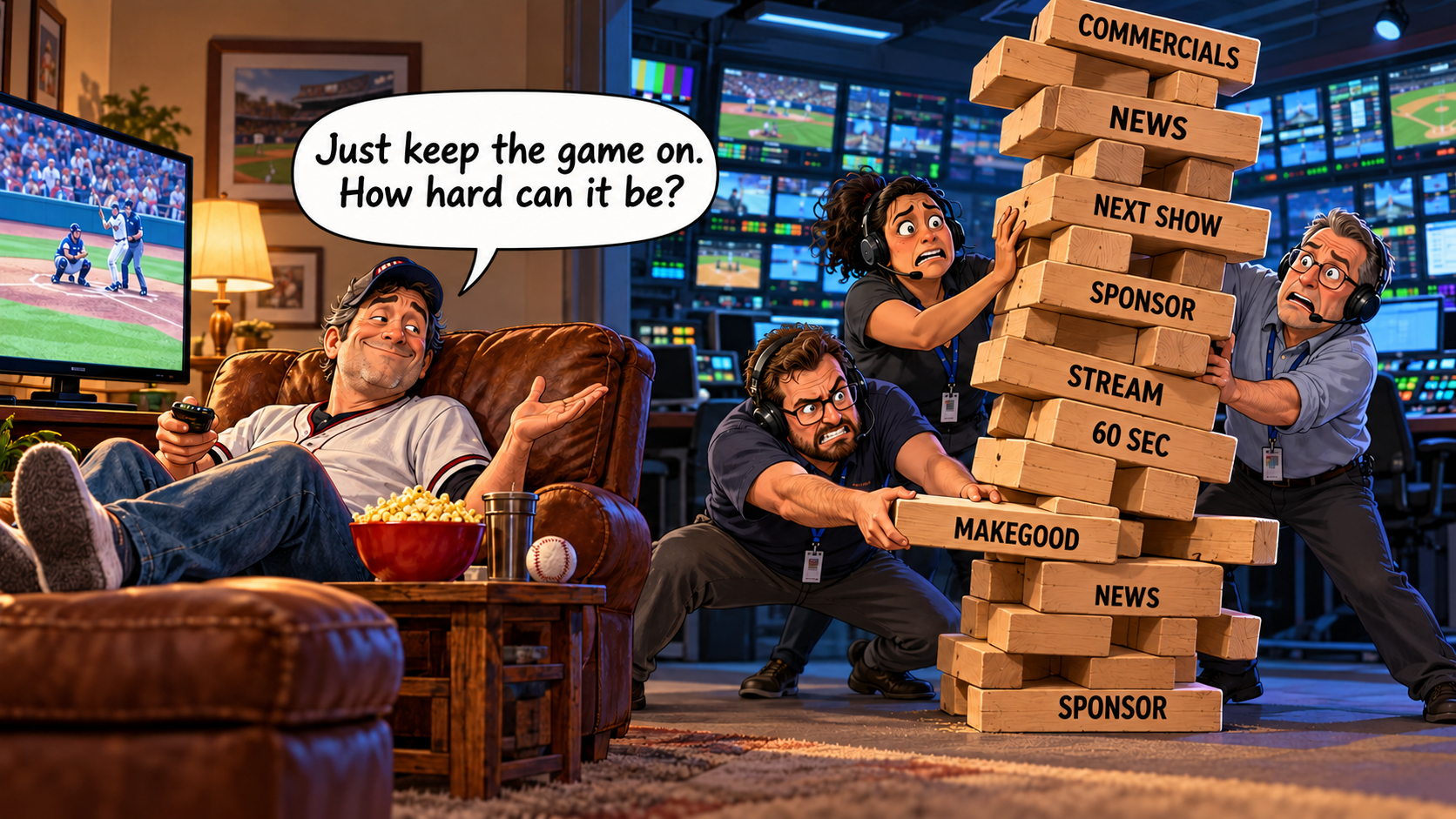
The game was supposed to end at 10:00 p.m.
At 10:07, it is still on. The next program is ready, its commercials are scheduled, and the rest of the evening assumes the handoff has already happened.
From the couch, the decision seems easy: keep showing the game.
Inside the operation, that decision sets several others in motion. Programming needs to determine what follows. Traffic needs to understand what happens to the commercial inventory. Master control needs an executable plan. Streaming teams, affiliates, distribution partners, and promotions may need updates of their own.
And by Monday morning, everyone has had time to decide what should have happened.
The Monday morning armchair discussion
We know how this conversation sounds.
“They should have stayed with the game.”
“They should have switched over sooner.”
“Why didn’t they just move the commercials?”
“Couldn’t they have put the rest on the stream?”
Some of those questions may be fair. But the Monday morning armchair discussion has an advantage the people working the event did not: the ending is already known.
On Monday, we know how long the overrun lasted. During the broadcast, the team was working with estimates, changing information, and a shrinking window to act.
That difference matters when we evaluate the decisions. A choice that looks obvious afterward may have depended on information nobody had yet—or approval that had not arrived.
There is still value in reviewing what happened. The useful discussion starts by reconstructing what the team knew, what options were available, and who had authority to act at the time.
Otherwise, we leave the meeting with strong opinions and the same unresolved workflow.
One overrun creates several decisions
“Push the schedule back” sounds simple until the next commitment cannot move.
Imagine coverage ends 12 minutes late, but another live event must begin at its original time. Those 12 minutes have to come from somewhere. A postgame show might be shortened. A segment might be dropped. A commercial placement might need review.
Each choice affects a different part of the operation.
Programming can approve a shorter show, but traffic still needs to understand the commercial consequences. Traffic can revise a placement, but master control needs the approved revision in time to execute it. Distribution may need a separate instruction for a destination that does not follow the television schedule.
The risk grows when each department solves its own part using a different version of the plan.
By Monday, that can look like someone failed to follow instructions. During the event, the instructions may never have been complete, shared, or acknowledged.
“Move the commercials” leaves questions open
A commercial break represents more than a few minutes on the clock.
Depending on the agreement, a spot may have placement requirements, sponsorship associations, separation rules, or delivery expectations that limit where it can move. Shifting it into another program may require review. Holding it for another day creates follow-up work.
That is why “we’ll make it up later” needs an owner and a documented disposition.
What aired? What moved? What was omitted? What still needs sales review?
The broadcast can recover on screen while leaving commercial discrepancies behind. Those discrepancies surface later in reconciliation, reporting, client conversations, and additional staff time.
A smooth transition for the viewer does not tell us whether every obligation was resolved.
The stream has its own workflow
“Put it on streaming” is another easy Monday morning answer.
Before that becomes an operating instruction, the team needs to know whether the destination can carry the coverage under the applicable arrangements, whether it is ready, and what happens to its advertising and audience information.
A television channel may need to reach its next scheduled program. A dedicated stream may have a different event window. An affiliate or distribution partner may require a specific handoff.
One decision to continue the game therefore may need several destination-specific decisions behind it.
The audience also needs to understand where coverage is going. If the operational change and the viewer message do not line up, a technically successful handoff can still be a confusing experience.
Tools can support the decision
A calculator can establish how much time remains before the next fixed start. A revised log can show the approved sequence. Reconciliation can compare the plan with the actual transmission record.
AI assistance can help organize the information, identify missing inputs, or draft a change notice for review. It can also make a timing tool easier to use by translating a plain-language question into visible fields and a verified calculation.
Those capabilities depend on the information supplied. A tool cannot resolve an unrecorded approval or determine a commercial commitment that nobody has provided.
The team still needs clear authority, current information, and a shared understanding of what has been approved.
Make Monday useful for the next game
The most productive Monday morning discussion looks beyond whether the final choice was popular.
When did the team recognize the likely overrun? Which decisions were already covered by the contingency plan? Where did someone have to wait for approval? Did every affected team receive the same revision? What remained unresolved after coverage ended?
Those questions make the review specific enough to improve the next event.
They also give us a fairer way to assess the people handling the broadcast. We can distinguish a decision made with the information available from a delay caused by unclear ownership, incomplete instructions, or a missing handoff.
The takeaway: A sports overrun tests how quickly the operation can reach and execute a shared decision while the outcome is still uncertain. Monday morning is the opportunity to examine that process and close the gaps before the next game.
Does your overrun plan connect programming, traffic, playout, and every distribution destination? Book a complimentary Fit Call with Broadcast Workflow Desk to discuss where your handoffs need greater clarity.